
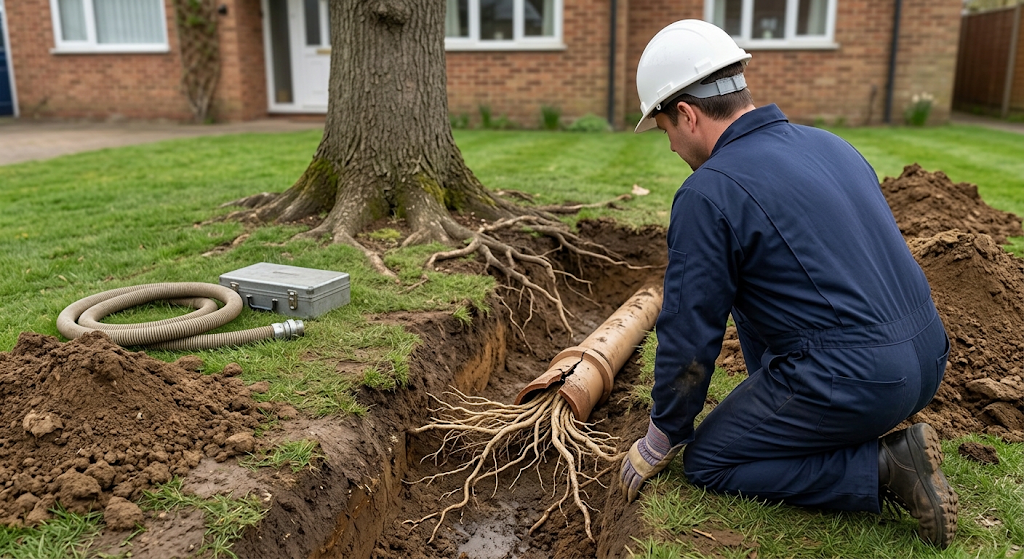
Homeowners budget for kitchens, roofs and paint. Almost nobody budgets for the pipe running under the front lawn. It works quietly for decades, asks for nothing, and then delivers its first status update as water spreading across a basement floor. Some of that is avoidable.
The Pipe You Own Without Knowing It
The sewer lateral runs from the foundation of a house to the municipal main under the street. In most jurisdictions the homeowner owns that entire run, including the section beneath the sidewalk and the public road. Plenty of people assume the city takes over at the property line. It usually does not.
Roots go wherever the moisture is, and a slightly loose pipe joint amounts to a standing invitation. One widely cited review of the research reported roots behind up to half of all sewer blockages, which sounds exaggerated until you picture a clay pipe sitting a couple of metres under a mature garden. A Danish survey put the share of towns reporting root intrusion somewhere in their network at 97 percent. Almost nobody escapes it.
Cost is where most owners freeze up. Anyone weighing the roots in pipes removal cost Mississauga against the price of digging up the yard and replacing the line tends to discover that cutting and flushing the existing pipe lands far lower; an older study of municipal systems estimated root removal at roughly one sixth of full renewal, though private homes vary too much for one number to travel well. Sending a camera down the line first is the cheap part of the job. Skipping it is how people end up paying twice.
What the Water Bill Knows First
The numbers on household leaks are genuinely odd. American homes lose close to a trillion gallons a year to drips and running toilets, a figure so large it stops meaning anything, so scale it down: the average household wastes somewhere between 9,300 and 10,000 gallons annually, depending which EPA page you land on. Roughly 270 loads of laundry, gone, usually through a rubber flapper that costs less than lunch. When did anyone last check their meter?
Insurance data tells a blunter story. Between 2019 and 2023, water damage and freezing made up about 22.6 percent of home insurance claims in the US, second only to wind and hail, with the average claim landing near $15,400. Earlier five-year windows put the average closer to $13,954, so treat the figure as a range rather than a fact carved in stone. Either way, one in roughly 67 insured homes files a claim like this every year.
Most of these problems announce themselves quietly before they get expensive. Worth paying attention to:
- A toilet that gurgles when the washing machine drains
- Drains that clear slowly in more than one room at once
- Damp patches on a basement wall that appear after heavy rain and fade by Thursday
- Bills creeping upward while nothing about the household changed
- Somewhere near a floor drain, a faintly sour smell nobody can trace
The Twenty Minute Walk Around
Pick a dry Saturday and go looking for trouble on purpose. You do not need tools, only a phone camera and a willingness to crouch. Photograph anything suspicious, because next spring you will not remember what the wall looked like.
- Find your cleanout, the capped access point on the lateral, usually near the property line or in the basement. Knowing where it sits saves a plumber twenty minutes at three in the morning.
- Two hours with nobody touching a tap, then compare the meter reading before and after. Any movement points to a leak.
- Look at what you have planted within six metres of the line. Willows, silver maples and poplars have earned their reputation.
- Test the sump pump by pouring a bucket of water into the pit. If nothing happens, better to learn that in September.
- Run your hand along visible pipe joints in the basement. Dry is good. Chalky white residue means slow weeping.
Age Does Most of the Damage
Pipe material matters more than anything a homeowner controls day to day. Vitrified clay and older concrete lines crack at the joints and invite roots in, while one study found intrusions dropped sharply in pipes laid after 1970, once PVC took over. Houses built before that are running on infrastructure their original owners never expected to outlive them.
None of this requires a renovation budget. It requires knowing what is down there, and checking it before the pipe decides to tell you itself.
